Many construction professionals are worried.
AI can now draft specifications, check models, generate design options, build scripts, and write reports. If AI can do that, what’s left for us? Educators share the same worry from a different angle. How are we preparing our students to face AI?
The worry is fair. But we need to see it from a different perspective.
If AI calculates the QTO wrong, who pays for the loss? If a structure fails, who takes the responsibility?
Not the AI. AI never take responsibility. People do.
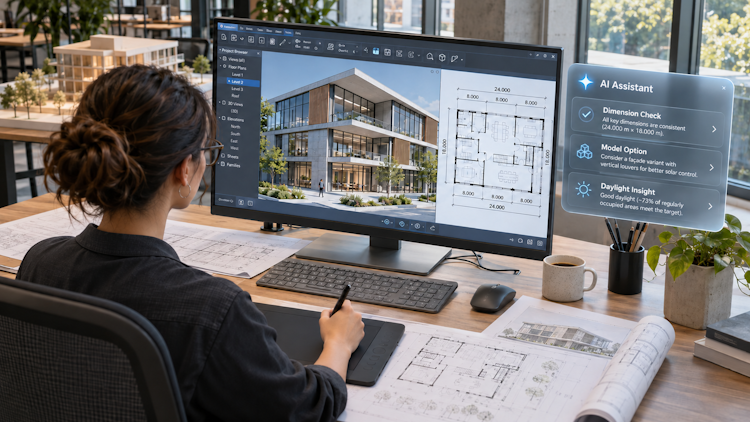
AI is an assistant, not a replacement
We should position AI as an assistant. It helps us work faster, but it doesn’t take over a professional’s role.
A professional directs the task. AI does the work. The professional reviews the result and decides.
Why? Because people understand context, regulation and physics. AI doesn’t, inherently. It predicts what looks right. It doesn’t know why a beam fails, which code applies to this site, or what the client actually needs. AI makes mistakes. A lot of mistakes.
So the role and the accountability stay with the person.
AI use needs governance
An assistant still needs rules: which tools, what data, who checks the output, who is accountable. For now, ISO/IEC 42001 is a useful reference. It isn’t mandatory for most of us, but it shows what governed AI use looks like.
ISO/IEC 42001 is the international, voluntary standard for AI management systems. Among other things, it asks organizations to:
- set an AI policy and assign clear roles and responsibilities
- assess AI risks and the impact of AI systems on people before deployment
- make sure staff are competent to use and oversee AI
- keep human oversight and monitor AI while it’s in use
The message is clear. Use AI, but govern it. Keep people in charge, competent and accountable.
That’s not job loss. It’s job change.
What changes for professionals
AI makes production cheaper. It doesn’t make judgment cheaper.
So prepare here:
- Know your domain deeper, not shallower. You can’t verify an AI-generated check if you don’t understand the load path behind it.
- Learn to direct and review. Give AI a clear task, then check the result like work from a fast junior.
- Understand information. AI works on your data. Messy models and documents give you mess, faster. Information management (ISO 19650, CDE) becomes more valuable, not less.
- Know the rules of use. Uploading project data to any AI tool you find is a risk, not a shortcut.
The people at risk are not the ones whose tasks AI can do. They are the ones who only do those tasks but don’t know how it works.
What changes for educators
Banning AI in class doesn’t prepare students. Letting AI do the assignment doesn’t either.
A few adjustments:
- Grade the reasoning, not only the result. Ask students to explain, defend and correct an output.
- Give them AI output to review. Let them find the errors in an AI-generated BoQ, schedule or clash report. That’s a skill the industry will hire for.
- Teach fundamentals harder. Structure, building physics, construction methods, contracts. Fundamentals are what make verification possible.
- Introduce governance early. Students who understand ISO 19650 and ISO/IEC 42001 concepts start ahead.
The Bottom Line
AI will take tasks. It already does.
References like ISO/IEC 42001 point the same way: people direct AI, review its output and stay accountable. Find if your country already has AI governance regulation. It should be offering the same concept.
The question isn’t whether AI will replace you. It’s whether you can use it as your assistant, and be the one who checks it.
AI can draw the detail. It still can’t sign the drawing.


