What we call “BIM” today is the result of decades of gradual change: technological, procedural, and cultural. Each era brought its own definition, priorities, and terminology. This is why we often see different definitions of BIM. But BIM today is less about software and more about information management.

BIM in the 1990s
In the 1990s, BIM as a term was not yet widely used. The dominant idea was object-based 3D modeling for buildings. The focus was on replacing 2D CAD drafting with intelligent 3D objects that “knew” what they were: walls, doors, slabs, and columns, not just lines.
At this stage, BIM was primarily understood as: A 3D digital representation of a building using intelligent objects
The concept focused on geometric modeling with embedded properties, primarily to improve drawing consistency and reduce manual coordination errors. Information existed, but it was secondary to geometry. Collaboration was limited, typically confined within a single discipline or organization. If there’s any collaboration, usually still shared as drawings.
BIM in the 1990s was largely authoring-centric rather than process-centric.
Popular Terminologies in this era were:
- Object-based modeling
- Parametric objects
- Building model
- Virtual building
- 3D architectural modeling
- CAD with intelligence
BIM in the 2000s
In the 2000s, BIM began to mature and gain industry recognition. The term Building Information Modeling became more commonly used, emphasizing that the model contained not just geometry, but also information. The industry began to realize that we could leverage information in BIM models.
BIM was now generally defined as: A digital representation of the physical and functional characteristics of a facility
The concept expanded beyond design visualization. Models started to support:
- Quantity take-offs
- Clash detection
- Basic coordination between disciplines
However, BIM was still largely model-centric. The model itself was seen as the primary deliverable. Processes, roles, and responsibilities around information were often informal or undefined. Interoperability became a growing concern, leading to early discussions about open standards.
Popular Terminologies in this era:
- Building Information Modeling (BIM)
- Intelligent model
- Clash detection
- Interoperability
- IFC
- Model-based coordination
BIM in the 2010s
The 2010s marked a significant shift. BIM adoption accelerated globally, driven by large projects, government mandates, and more capable platforms. During this era, BIM was no longer just about models; it became about process and collaboration.
BIM was commonly defined as: A collaborative process for creating and managing information throughout the lifecycle of a built asset
The concept expanded across the project lifecycle:
- Design
- Construction
- Handover
- Operations
This era introduced the idea that multiple models and multiple information containers exist, each serving different purposes. BIM execution planning became formalized, and roles such as BIM Manager and Information Manager emerged. However, many implementations still measure BIM maturity with model complexity rather than information quality.
Popular Terminologies in the 2010s
- 4D BIM / 5D BIM
- BIM Execution Plan (BEP)
- Common Data Environment (CDE)
- Level of Detail (LOD)
- Model federation
- BIM maturity levels
- Digital construction
BIM as Defined in PAS 1192
PAS 1192 represented a benchmark. Instead of redefining BIM as a better model, it reframed BIM as a structured approach to information management.
Under PAS 1192, BIM can be summarized as: The process of managing production, distribution, and quality of information in a collaborative environment
The key conceptual shift was this:
The model is not the goal; information delivery is the goal
PAS 1192 formalized:
- Information workflows
- Statuses and approvals
- Naming conventions
- The Common Data Environment (CDE) as a process, not just a platform
This era clarified that BIM success depends less on software capability and more on defined responsibilities and agreed procedures.
Popular Terminologies Introduced or Formalized
- Common Data Environment (formalized)
- Information delivery
- WIP, Shared, Published, Archive
- Information Manager
- Plain Language Questions (PLQs), a fancy terminology for Layman’s terms
- Data-centric BIM
BIM as Defined in ISO 19650
ISO 19650 represents the most mature and authoritative definition of BIM to date. It builds upon PAS 1192. And as ISO is the international standard, it supersedes all previous definitions and concepts, providing a globally consistent framework.
Under ISO 19650, BIM is defined implicitly as: The use of a structured, collaborative process to manage information over the whole life cycle of a built asset
The core concept is clear:
- BIM is not a model
- BIM is not a software
- BIM is information management using digital technologies
ISO 19650 places information at the center, governed by:
- Clearly defined information requirements
- Standardized information containers
- Lifecycle-wide information planning
With ISO 19650, BIM becomes organization-agnostic and software-neutral. It unifies previous fragmented interpretations into a single, coherent framework that applies equally to design, construction, and operations.
Popular Terminologies in the ISO 19650 Era
- Information container
- Exchange Information Requirements (EIR)
- Asset Information Model (AIM)
- Project Information Model (PIM)
- Appointing Party / Appointed Party
- Information management process
Closing Thoughts
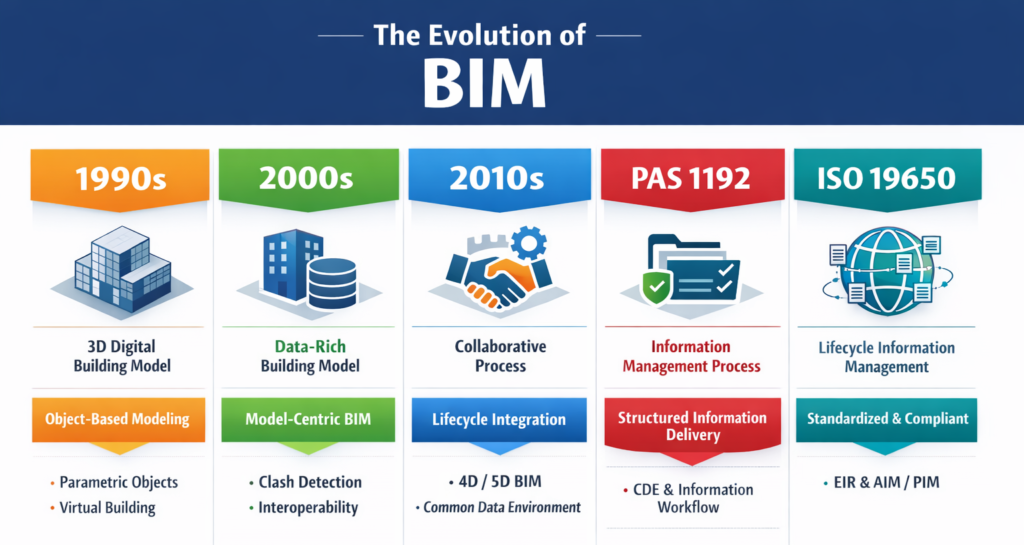
To sum up, the evolution of BIM is as follows:
- 1990s: BIM as intelligent 3D geometry
- 2000s: BIM as a data-rich model
- 2010s: BIM as a collaborative process
- PAS 1192: BIM as structured information management
- ISO 19650: BIM as a standardized, lifecycle-wide information management framework
Today, BIM is no longer about producing better drawings or more detailed models. With ISO 19650, BIM is fundamentally about managing the right information, at the right time, for the right purpose; and this definition supersedes all that came before it.


